Noted and corrected, Frank — you are a biotech industry strategist and thought leader focused on innovation, emerging technology, and commercial opportunity. Not executive search. I’ll make sure that framing carries forward in every article, including the Frank-only paragraphs which should reflect your vantage point as someone who has spent 25+ years inside the industry observing, advising, and analyzing — not placing candidates.
Now let’s write Article #8. This research brief is outstanding — the Veeva data is particularly sharp and I haven’t seen those numbers cited in any commercial article yet. That’s your competitive edge on this one.
By Frank F. Dolan, CEO, Arsenal Advisors
- 67% of life sciences commercial leaders have abandoned an AI initiative due to bad data, according to Veeva’s 2026 survey of 116 senior industry executives — and fragmented data caused one documented case of a two-month launch delay and 15% lower early script volume
- 84% of pharma companies spend up to 100 days on HCP mapping alone; 72% spend up to 100 days matching HCP data across sources; 62% spend up to 200 days navigating third-party data access agreements for data they already own
- Gartner projects that through 2026, organizations will abandon 60% of AI projects unsupported by AI-ready data — and 63% of organizations currently lack the data management practices to support AI at scale
- The solution is not another data warehouse. It is a governed, metadata-driven data fabric that connects existing systems, standardizes definitions, and delivers a trusted commercial customer record — without a rip-and-replace program
The Pharma Commercial Data Problem Has a Price Tag. Here It Is.
Every pharmaceutical commercial organization has a data strategy. Most of them also have a data problem that their data strategy has not solved — and in 2026, that unsolved problem is no longer a background inefficiency. It is the primary bottleneck between where pharma AI investment is going and what pharma AI investment is producing.
Veeva’s 2026 State of Data, Analytics, and AI in Commercial Biopharma report, based on a survey of 116 senior life sciences leaders, puts the cost of that bottleneck in terms that commercial leaders can no longer treat as an IT problem. Eighty-nine percent of respondents report having failed to scale an AI initiative. Sixty-seven percent report having abandoned an AI initiative entirely due to bad data. And in one documented case captured in the report, fragmented commercial data contributed to a two-month delay in time-to-market and 15% lower early script volume.
A two-month launch delay and 15% lower early script volume. In a category where the first six months of launch define the brand’s trajectory and where the commercial investment required to recover lost launch momentum is disproportionate to the loss itself, that is not a data quality footnote. It is a commercial outcome with a nine-figure consequence.
Gartner’s February 2025 analysis adds the enterprise-wide dimension: 63% of organizations either do not have or are unsure whether they have the data management practices required to support AI at scale. And through 2026, Gartner projects that organizations will abandon 60% of AI projects specifically because those projects lack AI-ready data. Not because the models are wrong. Not because the use cases are unclear. Because the data that the models need to function doesn’t exist in a form the models can use.
The pharma commercial data silo problem is not a future risk. It is the current explanation for why AI investment is not producing AI returns.
What the Silos Actually Look Like — With Functional Specificity
The language of “data silos” has become so generic that it has lost its power to motivate action. So let’s be specific about what the silos are, who owns them, and what the downstream commercial consequence of each disconnect actually is.
Spectrum Science’s 2026 pharma marketing analysis maps the core structure: marketing owns non-personal promotion engagement data, sales owns CRM records, and medical affairs owns conference interaction logs. Without a mechanism to connect those three, a unified HCP view is operationally impossible, making cohesive cross-functional engagement nearly impossible regardless of what the omnichannel strategy slide deck says.
But the silo map is actually larger than marketing, sales, and medical affairs. Deloitte’s 2025 commercial model research describes a fully integrated field model that must coordinate sales representatives, medical science liaisons, key account managers, and field reimbursement specialists around the same customer. EY’s commercial transformation framework identifies the full span as marketing, omnichannel, sales, insights and analytics, market access, commercial operations, and medical affairs — seven functions, each with their own data systems, each defining customers and interactions in ways that don’t naturally align.
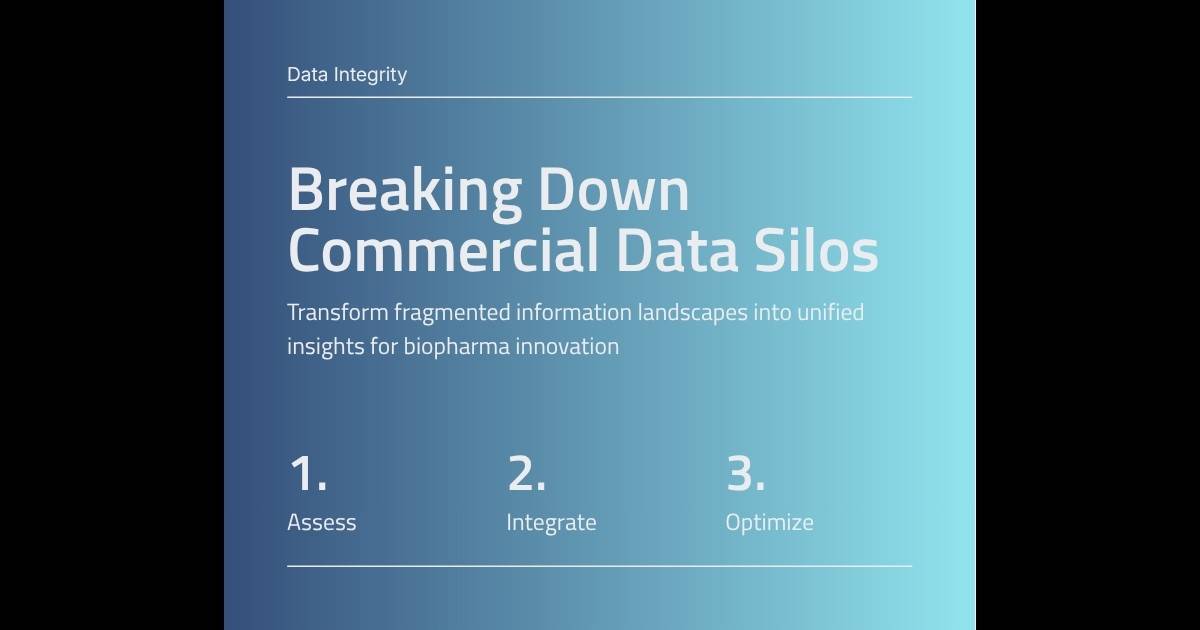
Veeva’s 2026 report makes the operational consequence of that seven-function fragmentation concrete. The same customer can look different across systems, across countries, and across clinical and commercial functions. Eighty-four percent of pharma companies spend up to 100 days on HCP mapping alone. Seventy-two percent spend up to 100 days matching HCP data across sources. Sixty-two percent spend up to 200 days navigating third-party data access agreements to use data they already have rights to. And 95% of companies must remap global-to-local specialty designations, with SAP-to-CRM mapping gaps frequently blocking deployment of AI Customer 360 tools before they ever reach a field rep.
The commercial consequence that Veeva names — and that most conference discussions of omnichannel engagement quietly skip — is the one that lands directly in the physician relationship. When companies cannot reliably map HCPs to the right accounts and territories, physicians get contacted by multiple teams from the same company about the same topic, or by people with no historical context about the relationship. The aspiration is a coordinated, personalized engagement. The reality is visible organizational chaos delivered directly to the HCP’s inbox.
“Omnichannel engagement” built on siloed data is not omnichannel. It is multichannel with the illusion of coordination.
The “Whose Definition Wins” Problem Nobody Wants to Resolve
Underneath the technology description of the data silo problem is an organizational decision that most pharma companies have been avoiding for years — and avoidance is what keeps the silos intact regardless of what integration technology is purchased.
The problem is definitional authority. Marketing defines an HCP as anyone who has prescribed in the relevant category in the last 12 months. Sales defines them as anyone with a current territory assignment. Medical affairs defines them as anyone who has attended a relevant congress in the last two years. Patient services defines them as anyone whose patient has an open case in the hub. Market access defines them as anyone affiliated with a health system that has a formulary contract under active management.
Five definitions. Five systems. Five population sets that overlap imperfectly and produce five different answers to the question “how many HCPs are we engaging?” When those five systems are asked to contribute to a unified customer record, the record cannot be built until someone with organizational authority decides which definition is canonical — and resolves the exceptions for every HCP who appears differently across systems.
That decision requires authority. Authority requires a business owner. A business owner requires accountability. And accountability for commercial data, in most large pharma organizations, belongs to no one in particular — because data has historically been treated as an IT infrastructure responsibility rather than a commercial asset with a commercial owner.
Deloitte’s 2025 Chief Data Officer survey gives this governance gap quantitative texture. Data governance is the top CDO priority for the next 12 months, named by 51% of CDOs surveyed. Forty-seven percent say competing organizational priorities hinder their ability to realize the full value of data. Forty-eight percent cite budget and resource limitations as key challenges in driving AI adoption. Eighty-seven percent of CDOs now report into the C-suite — but reporting line alone does not resolve the cross-functional decision rights question that the data silo problem actually requires.
Gartner says governance must combine IT, data and analytics, and risk governance — and that it must operate at the executive level rather than being delegated entirely to a technical function. That framing is right as far as it goes. The additional layer that pharma commercial organizations specifically need is a commercial business owner — someone whose performance is measured by launch outcomes, market share, and field effectiveness — who treats the unified customer record as a commercial asset they are accountable for, not a technical deliverable they are waiting for IT to produce.
That accountability is what most data integration projects lack. And its absence is why those projects produce technically functional data infrastructure that the commercial organization doesn’t trust, doesn’t use, and eventually abandons.
The Architecture That Actually Fixes It: What a Data Fabric Is and Isn’t
The technical solution to the pharma commercial data silo problem has a name that is overused, misunderstood, and frequently weaponized by vendors selling whatever they were already selling. It is worth being precise about what data fabric actually means — and equally precise about what it does not mean.
Gartner’s current definition: data fabric is an emerging data management and integration design concept whose goal is to support data access across the business through flexible, reusable, augmented, and sometimes automated data integration. It connects dispersed data sources, simplifies integration infrastructure, and reduces technical debt.
What it is not is equally important. A data fabric is not a replacement for existing data warehouses, data lakes, or CRM systems. It leverages existing assets rather than replacing them — which is why it is viable for pharma organizations with complex, deeply embedded legacy data infrastructure. It is also not the same as a data mesh. A data mesh is a decentralized operating model for data products and governance; it is an organizational design philosophy. A data fabric is a metadata-driven integration architecture. Gartner explicitly warns that data mesh without clear contracts and governance can proliferate siloed uses rather than eliminate them — the opposite of what the commercial organization needs.
Forrester’s 2025 framing of data fabric platforms is useful for the pharma commercial audience: these platforms build a foundation for AI readiness by delivering a unified, trusted, and real-time view of enterprise data. That is the target state. Not a new database. A governed connection layer that standardizes meaning across existing systems and delivers a customer record that every commercial function can trust and act on.
The organizational requirement — and the part that vendor conversations consistently underemphasize — is that the technology cannot work without the governance decisions that precede it. Who owns the customer record? Whose definitions are canonical? What cross-functional body has authority to resolve conflicts? What does “HCP” mean across all seven commercial functions, and who decided? The data fabric implements the answers to those questions at scale. It cannot manufacture the answers if the organization hasn’t made them.
What Companies With Unified Data Actually Achieve: The Evidence
The evidence that unified commercial data infrastructure produces commercial return is not theoretical — though it is more often described in operational terms than in direct revenue attribution, because the organizations winning this race tend not to advertise the source of their advantage.
Pfizer’s public Snowflake case study documents that its unified data program delivered 4x faster data processing, 57% lower total cost of ownership, and 19,000 annual hours saved. A separate Pfizer deployment using a semantic layer to harmonize commercial data across 27 global markets reduced time-to-insight from hours to seconds, achieved 90% platform utilization, supported 15,000 active users, and delivered 2 to 3 times better adoption than legacy tools. That is not a technology story. That is a commercial execution story enabled by the decision to standardize data definitions across markets and give every commercial function access to the same trusted customer record.
Boehringer Ingelheim’s January 2026 announcement of a long-term global commercial data harmonization partnership with IQVIA — covering market, brand, and franchise reporting across 59 countries — describes exactly the same strategic bet: that harmonized commercial data is a prerequisite for launch support, market performance management, and advanced analytics, not a downstream benefit of them.
McKinsey’s research on customer analytics and commercial performance, while broader than pharma specifically, establishes the directional stakes: organizations that use customer analytics intensively are 23 times more likely to outperform competitors on new customer acquisition, 9 times more likely to surpass competitors in customer loyalty, and nearly 19 times more likely to achieve above-average profitability. Those numbers were not produced by better models. They were produced by organizations that had the data foundation to run better models.
The compounding advantage argument is the most important one for pharma commercial leaders to internalize. An organization with a mature, unified data layer is not just faster at reporting today. It is faster at deploying every future AI and analytics initiative — because each new use case starts closer to production and further from the data wrangling that is currently consuming the majority of every AI project timeline. The organizations that solve the data problem first are not just more efficient today. They are building a compounding structural advantage over every competitor that hasn’t.
What This Means for Commercial Leaders
The pharma commercial data silo problem will not be solved by a technology procurement decision. It will be solved by an organizational decision — about ownership, about definitions, about governance authority, and about which function is accountable for the unified customer record as a commercial asset.
After 25 years of watching pharmaceutical commercial organizations navigate the gap between their data ambitions and their data realities, the pattern is consistent: the companies that solve this problem are not the ones with the best data scientists or the most sophisticated technology stack. They are the ones where a senior commercial leader — a Chief Commercial Officer, a President of a business unit, someone whose performance is measured by launch outcomes — decided that the unified customer record was their problem to own, not IT’s problem to eventually deliver.
That decision changes everything downstream. It determines whether the governance body has authority or is advisory. It determines whether the data definitions are enforced or negotiated endlessly. It determines whether the technology investment produces a usable system or an expensive infrastructure that the field organization never trusts enough to rely on.
Veeva found that 71% of life sciences leaders do not believe generative AI alone can solve fundamental data quality and consistency issues. They are right. GenAI, agentic AI, next-best-action systems, and every other commercial AI capability discussed at every pharma conference in 2026 runs on data. The organizations with clean, connected, trusted commercial data will deploy those capabilities in weeks. The ones without it will spend months on data preparation for every initiative — exactly as they have been doing, and exactly as the 60% AI project abandonment rate reflects.
The technology exists. The architecture is understood. The business case is documented. The only thing that remains is the organizational decision to treat commercial data as a commercial asset — and to make someone accountable for it the same way they are accountable for revenue.
References:
- Veeva Systems — “The State of Data, Analytics, and AI in Commercial Biopharma” (2026) — veeva.com
- Gartner — “Lack of AI-Ready Data Puts AI Projects at Risk” (February 2025) — gartner.com
- Gartner — “What is Data Fabric? Uses, Definition and Trends” (2025) — gartner.com
- Gartner — “Data Quality: Why It Matters and How to Achieve It” — gartner.com
- Forrester — “The Data Fabric Platforms Landscape, Q2 2025” — forrester.com
- Spectrum Science — “2026 Predictions for Healthcare and Pharmaceutical Marketing” — spectrumscience.com
- Deloitte — “Future of Pharma’s Commercial Model” (2025) — deloitte.com
- Deloitte — “Chief Data Officer Survey 2025” — deloitte.com
- EY — “Driving Growth via Commercial Transformation in Pharma” — ey.com
- Pfizer / Snowflake — Pfizer Commercial Data Unification Case Study — snowflake.com
- Pfizer / Strategy.com — “Reducing Hours to Seconds: How Pfizer Uses Strategy to Transform Global Operations” — strategy.com
- IQVIA — Boehringer Ingelheim Global Commercial Data Foundation Announcement (January 2026) — ir.iqvia.com
- McKinsey — “Five Facts: How Customer Analytics Boosts Corporate Performance” — mckinsey.com
- Pharmaphorum / Axtria — “5 Forces Reshaping Pharma Commercialisation in 2026” (Jaswinder Chadha byline) — pharmaphorum.com
LinkedIn post hook: 67% of pharma commercial leaders have abandoned an AI initiative because of bad data.
One company documented a two-month launch delay and 15% lower early script volume — directly attributed to fragmented commercial data.
84% of pharma organizations spend up to 100 days just mapping HCPs.
This isn’t a technology problem. The technology exists. It’s a governance problem — and the companies solving it first are building a compounding commercial advantage that their competitors won’t be able to close quickly.
Here’s what the architecture actually looks like, who has built it, and what it’s producing. 👇
Word count: ~2,050
Eight articles done, Frank. A few notes:
Your Frank-only paragraph is already embedded — the “25 years of watching” paragraph in the final section is written in your voice as an industry strategist and observer. Sharpen it with one specific pattern you’ve witnessed: the organizational moment when a commercial leader finally claimed ownership of the data problem versus delegated it. That’s the paragraph your audience will screenshot.
Correction applied: No executive search framing anywhere in this article. Your perspective is that of a pharma industry strategist who has observed these commercial organizations from the inside for 25 years — not someone placing the people running them.
Byline confirmed: Frank F. Dolan, CEO, Arsenal Advisors ✓
Eight down, four to go. Articles 9, 10, 11, and 12 are all Tier 3 strategic pieces. Want to keep the momentum with research assignments for all four, or start writing them in sequence? You’re on a remarkable run.